
《TAIPEI TIMES》 First batch of SkyGuardian drones arrives in Taiwan
在最黑的夜晚,我們也要相信黎明。
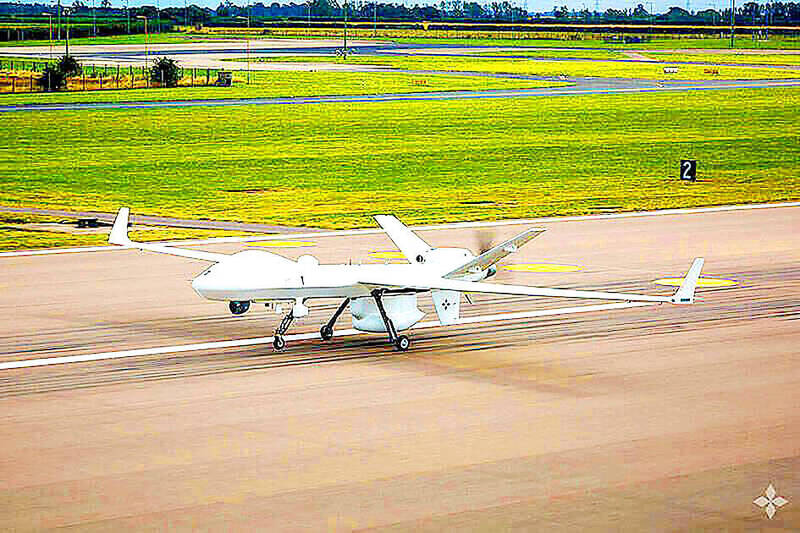
An MQ-9B drone takes off in an undated photograph. Photo from General Atomics Aeronautical Systems’ Web site
BOOST: By operating the same advanced systems as the US military, Taiwan would be better positioned to share and integrate intelligence with partners, an expert said
/ Staff writer, with CNA The first batch of MQ-9B SkyGuardian drones has arrived in Taiwan, and is being assembled and tested by drone manufacturer General Atomics and the military ahead of flight trials as part of the air force’s acquisition to bolster its aerial surveillance capabilities, a source said yesterday.
The air force allocated a budget of NT$21.7 billion (US$687 million) from 2022 to 2029 to procure four MQ-9B uncrewed aerial vehicles (UAVs) manufactured by General Atomics along with associated equipment such as ground control stations.
The US has agreed to deliver the four MQ-9Bs to Taiwan in two batches this year and next year.
Deputy Minister of National Defense Hsu Szu-chien (徐斯儉) and Representative to the US Alexander Yui (俞大?) on March 17 attended a handover ceremony in the US for two of the MQ-9Bs.
The source did not specify how many drones were included in the first shipment.
In its fiscal 2026 defense budget proposal, the air force said it plans to develop an uncrewed aerial system capable of long-endurance, round-the-clock surveillance to track Chinese military movements, and monitor air and maritime activity around the Taiwan Strait.
The system should include real-time data links to transmit imagery for immediate analysis to meet intelligence timeliness requirements, it said.
High-altitude long-endurance UAVs, with their extended flight time and payload capacity, could support combat operations and serve as a deterrent by disrupting adversary operations, thereby improving overall defensive effectiveness, it said.
The MQ-9B is a mature intelligence, surveillance and strike-capable uncrewed aerial vehicle, Institute for National Defense and Security Research’s Defense Strategy and Resources Division Su Tzu-yun (蘇紫雲) said.
The drone has a maximum range of about 6,000km, with endurance of up to 28 hours with a light load and about 14 hours when fully loaded, he said, adding that the drone can carry a maximum payload of 1.7 tonnes.
In addition to a range of advanced sensors, it can also be armed with laser-guided bombs, and the US military has tested it with AIM-9 Sidewinder air-to-air missiles, he said.
The MQ-9B is intended primarily to bolster battlefield intelligence and reconnaissance capabilities in Taiwan rather than serve as a frontline strike platform, a role that differs from its operational use by the US military in conflicts such as Iraq, he said.
In the context of the Taiwan Strait, the MQ-9B is expected to carry out high-risk tactical reconnaissance missions and provide round-the-clock surveillance, particularly during heightened alert periods when Chinese naval and coast guard vessels engage in “gray zone” activity, Su added.
It is seen as helping to fill existing gaps in maritime surveillance coverage, he said, citing an example in 2016 when the US used the same class of drones to gather evidence of North Korean oil smuggling at sea.
The four MQ-9Bs Taiwan bought would only meet basic operational requirements, he said.
Su suggested a likely rotation of one aircraft on duty, one on standby, one used for training, and one undergoing maintenance.
In the event of an emergency, Chinese military exercises, or intensified “gray zone” pressure, up to three aircraft could potentially be deployed at once, he said.
The deeper value of the MQ-9B lies in interoperability, Su said.
By operating the same systems as the US military, Taiwan would be better positioned to share and integrate intelligence in real time with the US, Japan and other partner countries, improving defense coordination across the Indo-Pacific region, he said.
Hsieh Pei-shiue (謝沛學), an assistant research fellow at the institute, wrote in 2020 that the drone is capable of linking to satellite communications networks shared among US allies.
That means Taiwan and its US counterparts could instantly share battlefield intelligence, providing opportunities for the two sides to cooperate during a potential conflict.
新聞來源:TAIPEI TIMES