
《TAIPEI TIMES》President touts democratic cooperation to address China's "gray zone"
守護記憶,就是守護未來。
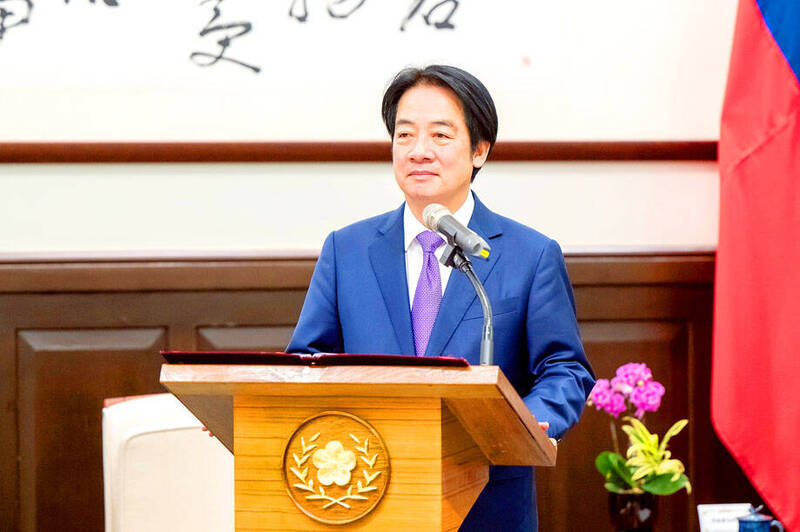
President William Lai speaks at the Presidential Office in Taipei yesterday. Photo: Screen grab from the Presidential Office’s Flickr page
CHINESE REPRESSION: Taiwan will continue working with international partners to defend freedom and democracy, Lai and the vice president said at separate meetings
By Chen Yun and Sam Garcia / Staff reporter, with staff writer
Taiwan will continue to strengthen cooperation with democratic partners to address the challenges posed by authoritarianism, as China’s continued military and “gray zone” activities have raised widespread international concern, President William Lai (賴清德) said yesterday.
Lai made the remarks at a meeting with a delegation from the US National Endowment for Democracy (NED) at the Presidential Office in Taipei.
The delegation included representatives from the NED’s key partners: the International Republican Institute, the National Democratic Institute, the Center for International Private Enterprise and the Solidarity Institute.
Lai thanked members of the delegation for standing with Taiwan, noting that it is NED president and CEO Damon Wilson’s fifth time visiting the nation.
This year marks the US’ 250th anniversary and the 30th anniversary of Taiwan’s first direct presidential election, Lai said.
Although Taiwan and the US are on opposite sides of the Pacific, their shared pursuit of democracy and freedom have connected them closely as they work together to confront global challenges, the president said.
In recent years, China’s continuous military activities and “gray zone” coercion against neighboring countries in the East China Sea, South China Sea and Taiwan Strait have seriously affected regional peace and stability, Lai said.
China’s transnational repression and surveillance, including the use of domestic laws to expand authoritarian influence, have drawn heightened international concern and vigilance, he added.
In the face of these multifaceted threats, Taiwan continues to strengthen its defense, trade, technology and energy resilience, and cooperation with democratic partners like the US, Lai said.
The Global Cooperation and Training Framework workshop last month in Taipei brought together like-minded countries to address transnational repression, aiming to strengthen democratic resilience and address the challenges posed by authoritarian expansion, he said.
The NED and its partners have long worked with the Taiwan Foundation for Democracy and other civil organizations, strengthening the connection between Taiwan and the rest of the world, Lai said.
Taiwan will continue to deepen cooperation with the US across democracy, security and trade, while jointly safeguarding a rules-based international order and promoting global peace and prosperity, he said.
Separately yesterday, Vice President Hsiao Bi-khim (蕭美琴) said during a meeting with a delegation from the Inter-Parliamentary Alliance on China at the Presidential Office that China’s launch of an intercontinental ballistic missile toward the South Pacific on Monday and other actions highlight its expanding “malign influence operations.”
As Beijing continues to apply political and economic pressure on Taiwan, Taiwan will continue working with international partners and like-minded countries to defend democracy and freedom, she said.
In related news, National Security Council Secretary-General Joseph Wu (吳釗燮) yesterday said that the missile launched by China on Monday was a JL-2, amid wide speculation that it was a JL-3.
Wu condemned the launch as a provocation that threatens stability in the Indo-Pacific region, saying the move demonstrated China’s continued role as a “regional bully.”
According to a flight path map Wu posted on X, the missile was launched from the South China Sea, flew over northern Luzon in the Philippines, and landed in international waters in the South Pacific between Nauru and Tonga.
Experts estimated the missile traveled about 7,000km, while some analyses put the full flight trajectory at more than 7,300km — a distance that closely aligns with the operational range of the JL-2.
新聞來源:TAIPEI TIMES
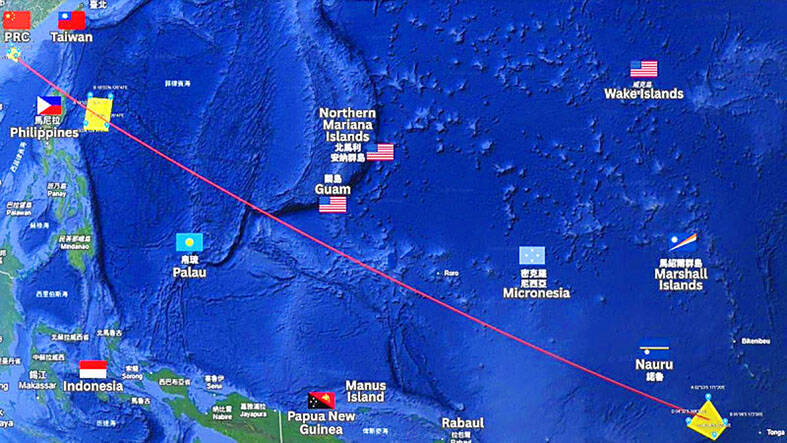
An image shows the path of a missile launched on Monday from the South China Sea that flew over northern Luzon in the Philippines, and landed in international waters in the South Pacific between Nauru and Tonga. Photo: Screen grab from Joseph Wu’s X account