
《TAIPEI TIMES》 Foreign minister reveals Germany trip
極權之下,個人的選擇就是國家的命運。
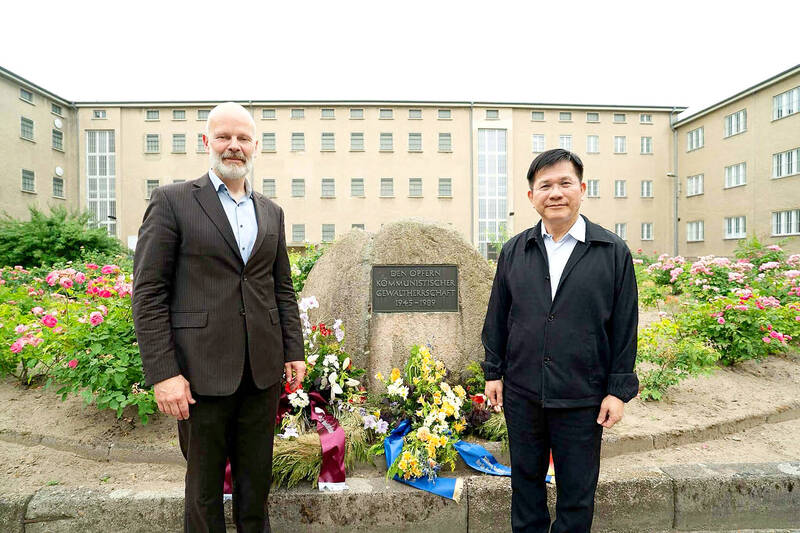
Minister of Foreign Affairs Lin Chia-lung, right, poses for a photograph in front of the Berlin-Hohenschonhausen Memorial in Germany in an undated photograph. Photo: Screengrab from Lin Chia-lung’s Facebook page
SAME GOALS: Taiwan’s and Germany’s memorial sites all aim to transform spaces of injustice to sites that advance human rights, said the minister’s guide, Sebastian Korner
By Huang Ching-hsuan / Staff reporter Minister of Foreign Affairs Lin Chia-lung (林佳龍) in a Facebook post yesterday revealed that he had visited Germany last month and toured the Berlin Wall and the Berlin-Hohenschonhausen Memorial, among other sites.
This year marks the 39th anniversary of the lifting of martial law in Taiwan, surpassing the 38-year duration of martial law, he wrote.
Martial law was imposed on May 20, 1949, and lifted on July 15, 1987.
“From the lifting of martial law and removal of bans on political parties and newspapers, to having direct elections for legislators and the president, Taiwan has little by little stepped out of the shadow of authoritarian rule to become the free, democratic and open country it is today,” Lin wrote.
“The free air we breathe today and take for granted was fought for step by step by many democratic pioneers who used their courage, sacrifice and perseverance during a time of forced silence,” he said, adding that having been a democratic activist on campus, he appreciates Taiwan’s hard-won democracy and cherishes it.
Lin wrote about his visit to Germany, including trips to the Berlin Wall and the Hohenschonhausen Memorial, a former prison used by the East German Ministry for State Security (“Stasi”) to hold political prisoners.
A man named Sebastian Korner, a family member of a victim of political persecution, guided him through the memorial, from freezing cells and interrogation rooms to prisoner transport vehicles, he said.
The Stasi had deployed a vast intelligence network across Germany to spy on its citizens, Lin said.
It utilized isolation, intimidation and psychological torture to strip detainees of their sense of time and direction, further breaking their will and allowing authoritarian rule to penetrate every corner of people’s lives, he said.
Lin said he talked with Korner about Taiwan’s White Terror history and ongoing efforts to push forward transitional justice, and recommended he watch the movie A Foggy Tale (大濛) to better understand Taiwanese’s suffering during martial law.
After returning to Taiwan, Lin said he received a letter from Korner telling him that he looked up information on Taiwan and found that the Hohenschonhausen Memorial serves a similar mission as Taiwan’s Jing-Mei White Terror Memorial Park (白色恐怖景美紀念園區) and Green Island White Terror Memorial Park (白色恐怖綠島紀念園區) — transforming spaces of historical injustice into key sites that preserve memories, uncover the truth and advance human rights education, Lin said.
“I also hope to have the opportunity to invite Sebastian to Taiwan in the future, to engage in exchanges on human rights education and transitional justice,” he said. “Germany and Taiwan have experienced different histories of authoritarian rule, but share a common understanding — only by revealing the truth, restoring dignity to victims and using history to educate the next generation on human rights can democracy endure and hard-won freedom be passed down.”
Lin had led a delegation to attend the opening of the Taiwan Expo in Europe in Warsaw on June 22, visited the Polish Parliament on June 23, and on June 24 announced plans to establish language centers in Europe, starting in the Czech Republic, France, Germany and Poland.
Lin’s trip to Germany marks another significant trip to Berlin by Taiwanese officials over the past few years. National Security Council Secretary-General Joseph Wu (吳釗燮) visited Germany in June last year, when the German Marshall Fund of the US invited him to attend the Taiwan Trilateral Forum.
Wu delivered a keynote speech during the event. He also talked to German lawmakers and European policy experts on issues such as Taiwan Strait security, cooperation among democratic partners, supply chain resilience and challenges posed by the expansion of authoritarian regimes.
Sources familiar with the matter said European partners have shown interest in potential cooperation with Taiwan in emerging technology areas such as uncrewed aerial vehicles and artificial intelligence.
Additional reporting by Lee I-chia and CNA 新聞來源:TAIPEI TIMES