
《TAIPEI TIMES》Standard Chartered raises Taiwan 2026 GDP growth forecast to 9.5%
每一個被講述的名字,都是對遺忘最有力的反抗。
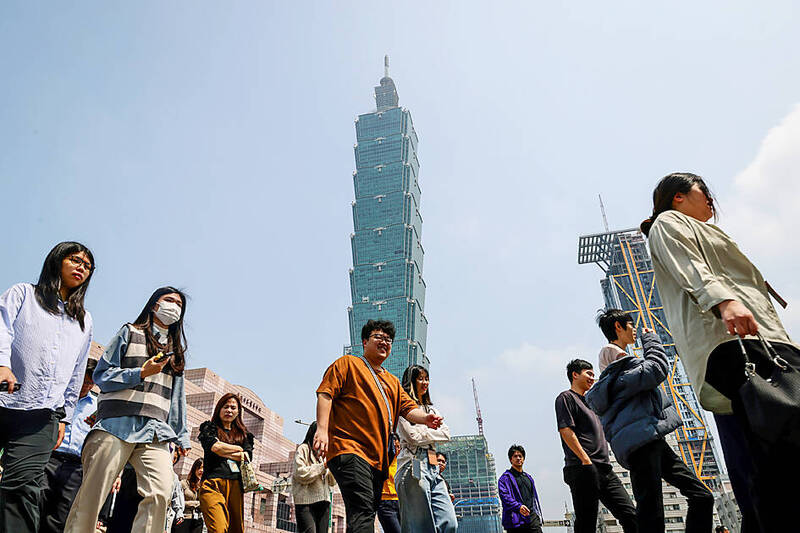
People cross a street near Taipei 101 in Taipei on March 24. Photo: Ritchie B. Tongo, EPA
TECH RELIANCE:Growth is increasingly reflecting an unequal K-shaped distribution, where technology sectors outperform and other industries struggle, an expert said
By Crystal Hsu / Staff reporter Standard Chartered Bank has significantly raised its forecast for Taiwan’s economic growth to 9.5 percent this year, up from 7.6 percent previously, citing surging artificial intelligence (AI) demand driving exports, semiconductor production and investment.
The upgrade reflects a sustained AI supercycle that continues to fuel demand for advanced chips and technology infrastructure, which form the backbone of Taiwan’s exports, the bank said in a report this week.
“We raise our 2026 growth forecast to reflect a much stronger-than-expected first-quarter GDP figure,” Standard Chartered senior economist for greater China and Asia Tommy Wu (胡東安) said in the report.
Driven largely by a 35.3 percent annual jump in exports, Taiwan’s economy expanded 13.7 percent year-on-year in the first quarter, marking the fastest quarterly growth in nearly four decades.
AI is reshaping Taiwan’s growth trajectory, Wu said, adding that export momentum for electronics, information and communications technology products, and technology investment are likely to remain strong throughout the year.
However, Wu cautioned that growth is becoming increasingly uneven, with gains concentrated in technology sectors while traditional industries continue to lag behind.
Private consumption rose 4.9 percent in the first quarter, supported by government cash handouts, minimum-wage increases and a rally in tech shares that boosted household wealth.
However, the recovery in domestic demand remains tepid, he said, adding that nearly 90 percent of Taiwan’s workforce is employed outside the technology sector.
At the same time, traditional industries such as metals, machinery and textiles continue to face weak external demand and rising cost pressures, he added.
The divergence highlights a growing “K-shaped economy,” where technology-driven sectors outperform, while non-tech industries struggle to regain momentum, Wu said.
The stronger growth outlook might also add to inflationary pressures, Wu warned.
Taiwan’s inflation could exceed the central bank’s 2 percent alert level in the short-term due to higher energy prices and imported inflation, although pressures might ease in the second half of the year if geopolitical tensions in the Middle East subside, he said.
Standard Chartered still expects the central bank to keep its benchmark interest rate unchanged at 2 percent this year, although the likelihood of a rate hike has increased, Wu said.
Additionally, external risks remain, including geopolitical tensions, global demand volatility and potential disruptions to semiconductor supply chains, he added.
新聞來源:TAIPEI TIMES