

《TAIPEI TIMES》Cross-strait talks losing appeal: poll
從來如此,便對麼?
—— 魯迅
Taoyuan National Development Education Foundation researcher Yang Hsi-hui, left, speaks at a press conference held by the foundation in Taipei yesterday. Photo: CNA
By Chen Yu-fu / Staff reporter Taiwanese support for cross-strait negotiations has fallen to 62 percent from nearly a decade earlier, with the majority preferring to maintain the “status quo,” a survey released yesterday by the Taoyuan National Development Education Foundation showed.
The tracking survey was first conducted in 2015 by the Center for China Studies at National Taiwan University’s College of Social Sciences, until it was taken over by the foundation this year, with the latest poll conducted last month.
Asked if they support cross-strait political negotiations, only 61.6 percent of respondents said yes, dropping from 78 percent in 2018, and 22.2 percent disapproved, the survey showed.
As to the urgency of holding talks, 31.5 percent said negotiations should be conducted as soon as possible, while 29.4 favored delaying it as much as possible, and 18.4 percent said it would depend on the situation
The 10-year polling data showed 30.4 percent putting their trust in the Democratic Progressive Party (DPP) to talk to China, while 26.9 percent chose the Chinese Nationalist Party (KMT), the poll showed.
Another 5 percent tapped the Taiwan People’s Party (TPP), and 9.1 percent said they do not trust any party.
Asked whom they trust more to lead the negotiations, former president Tsai Ing-wen (蔡英文) led with 21.8 percent, followed by President William Lai (賴清德) with 13.3 percent and Legislative Speaker Han Kuo-yu (韓國瑜) with 11.6 percent.
Other choices included KMT Chairwoman Cheng Li-wun (鄭麗文) with 8.5 percent, former Taipei mayor and TPP founder Ko Wen-je (柯文哲) with 3.3 percent, former president Ma Ying-jeou (馬英九) and TPP Chairman Huang Kuo-chang (黃國昌) with 3 percent each, and Taipei Mayor Chiang Wan-an (蔣萬安) with 1.6 percent.
Another 7.8 percent said they did not trust anyone to handle the negotiations, while 22.9 percent had no answer.
The poll showed that 58 percent of respondents do not accept that Beijing’s “one China” principle as a prerequisite for negotiations, while 25.8 percent do and 16.2 percent had no view.
Asked about their most desired political outcome, 44.3 percent hoped to maintain the “status quo,” while 27 percent wanted “Beijing to recognize Taiwan as a nation and the two countries to establish diplomatic relations.”
Another 15.9 percent hoped Beijing would recognize Taiwan as a nation, that they coexist with mutual non-aggression, but without establishing diplomatic relations. A mere 3.2 percent wished for unification with China.
The poll shows that what Taiwanese want is not the same as what Beijing wants, Center for China Studies director Tsai Chi-ting (蔡季廷) said.
Most Taiwanese refuse to accept China’s “one China” principle as a prerequisite for political negotiations, so even if the DPP or the KMT is willing to negotiate with China, it is difficult for either of them to take action as they clearly know what is the people’s “bottom line” for negotiations with China, he said.
CTBC Business School chair professor Chou Jih-shine (周繼祥) said that opposition parties are in no position to negotiate, as the Straits Exchange Foundation is the only agency authorized by the Mainland Affairs Council to negotiate with China.
Negotiation requires a formal process and talking idly is useless, he said, adding that political negotiations must have a bottom line, and Taiwan must not wait until “the enemy is at the gate, dictating what the unification model should be,” as that would be like taking “a lamb [Taiwan] to the slaughter,” he said.
Yang Hsi-hui (楊喜慧), a researcher at the foundation, said that the options “hoping Beijing recognizes Taiwan as a country” and “maintaining the status quo” received almost the same amount of support in Taiwan.
This deserves more attention from the international community, and Beijing should also take it seriously, Yang said.
The nationwide poll collected 1,068 valid samples, and had a margin of error of 3 percentage points.
Additional reporting by CNA 新聞來源:TAIPEI TIMES
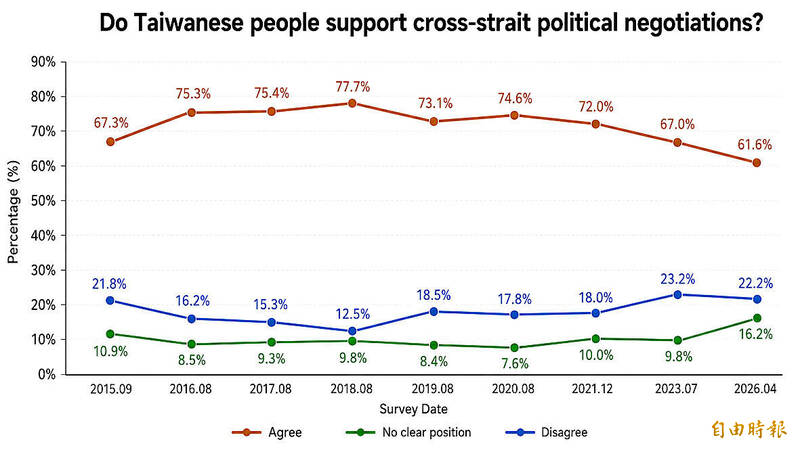
Source: Taoyuan National Development Education Foundation GRAPHIC: Taipei Times