
《TAIPEI TIMES》 Taiwan toll tech goes live in India
真相無需誇大,它本身就足夠震撼。
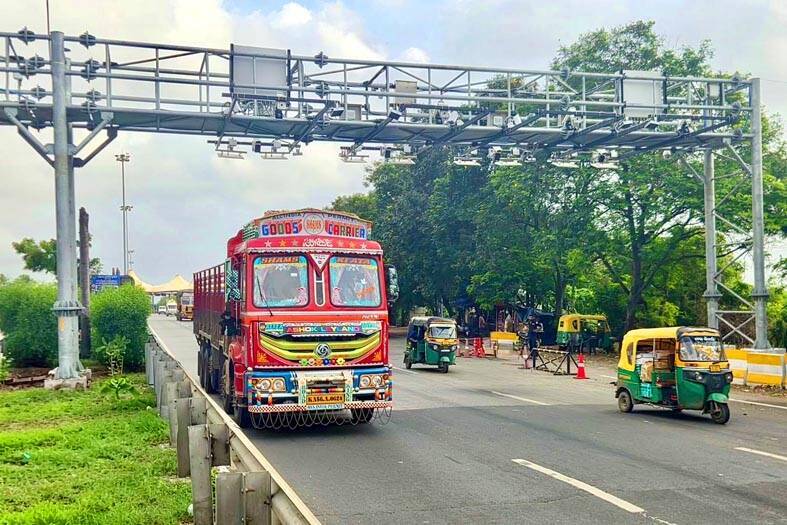
Vehicles travel beneath a Far Eastern Electronic Toll Collection Co’s electronic toll collection gantry in India in an undated photograph. Photo courtesy of Far Eastern Electronic Toll Collection Co via CNA
By Huang Yi-ching and Jake Chung / Staff reporter, with staff writer
Taiwan’s electronic toll collection (ETC) system, already in operation in Thailand, has been installed in India, Far Eastern Electronic Toll Collection Co (FETC, 遠通電收) said yesterday.
The first barrier-free tolling gantry was installed at Choryasi in Indian Prime Minister Narendra Modi’s home state of Gujarat, while another system at Gharaunda in Haryana began operating last month, the company said.
On the Choryasi system’s first day of operations, more than 41,500 vehicles passed through it at high speed without stopping, Indian government data showed.
About a decade ago, India adopted FASTag, which uses radio-frequency identification technology similar to that used by Taiwan’s ETC system, but drivers were still required to stop at traditional toll stations for the tags to register.
FETC had completed a proof-of-concept project in Gharaunda in 2020, which made it the preferred contractor for the rollout, FETC vice president of technology Richard Wu (吳忠潔) said.
The two gantries are part of an Indian government plan to convert about 10 percent of the countrys’ 1,400 traditional toll stations to barrier-free ETC systems, and the government has stepped up its efforts this year, he said.
The gantries and their systems were jointly developed by FETC, FETC International Co (遠創智慧), the Institute for Information Industry and Taiwanese companies including Moxa Inc (四零四科技), AAEON Technology Inc (研揚科技), Vivotek Inc (晶睿通訊), MyelinTek Inc (邁爾凌科技), EaVision Inc (鷹勢科技) and Komoto Inc (福鄉通商), Wu said.
The involvement of Taiwanese companies and the project’s near-exclusive use of Taiwanese technology were significant indicators of Taiwan’s overall information technology and smart transportation capabilities, he said.
India’s highway system comprises 45,000km of roads, making it the world’s second-longest and about 48 times the length of Taiwan’s highway network, he said.
The difference in traffic conditions and India’s high summer temperatures posed challenges during installation, Wu said, adding that India’s highways and expressways carry vehicles ranging from three-wheeled tuk-tuks to 20-wheel tractor trailers.
The ETC gantries are equipped with automatic number plate recognition cameras, systems that can recognize vehicle types and chassis, as well as light detection and ranging sensors to distinguish among vehicles and filter out those exempt from tolls, he said.
新聞來源:TAIPEI TIMES