
《TAIPEI TIMES》KMT-TPP drone bills an overstep: Lai
歷史是公正的,雖然它需要時間。
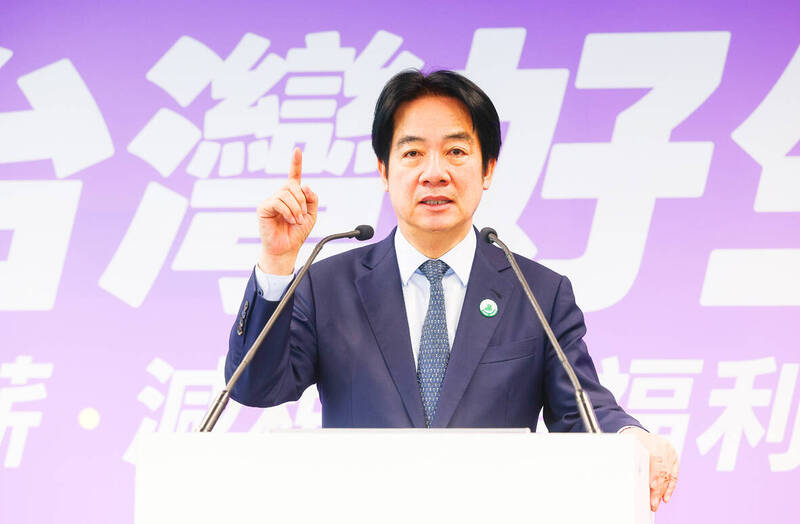
President William Lai speaks at a Democratic Progressive Party event in Taipei yesterday. Photo: CNA
RACE AGAINST TIME:With drone technology and the geopolitical landscape rapidly evolving, Taiwan must be able to invest effectively, the president said
By Chen Cheng-yu and Jonathan Chin / Staff reporter, with staff writer
Plans by opposition parties in the legislature to fund defense drone development through the annual budget would violate the division of powers stipulated by the Constitution and disrupt fiscal planning, President William Lai (賴清德) said yesterday.
The Chinese Nationalist Party (KMT) and the Taiwan People’s Party (TPP) on Monday presented their respective drone procurement bills.
Unlike the Cabinet’s proposal, which would provide NT$210 billion (US$6.6 billion) for the drone program through a special budget, the opposition’s drafts would seek to fund drones through the annual budget process.
Lai, who chairs the Democratic Progressive Party, told his party’s Central Executive Committee that the KMT and TPP proposals would infringe upon the Executive Yuan’s budget responsibilities, sources with knowledge of the meeting said.
Putting drone development funds in the annual budget would subject them to the national debt ceiling, which would not apply to the drone special budget, the sources cited Lai as saying.
That would deprive the Cabinet of the flexibility needed to invest effectively in a rapidly changing field that is critical to national defense, Lai said.
Adding subsidies for the drone industry and funding for defense projects to the annual budget would also curtail the government’s ability to allocate funds to education, welfare and other essential services, he said.
The Cabinet’s special budget proposal for drones, which features anticipated expenditures and project timetables, is the nation’s best hope for building a sustainable drone industry, the sources cited Lai as saying.
The special budget is necessary to reduce uncertainty for the drone sector and to give Taiwan’s armed forces urgently needed capabilities, he said.
Building up asymmetric warfare capabilities is a race against time amid massive changes in military technology and the geopolitical landscape, he said.
The government is trying to help Taiwan’s drone sector seize opportunities created by domestic and foreign demand for military uncrewed aerial vehicles as the industry focuses on developing non-Chinese supply chains and dual-use platforms, he said.
The opposition parties should support a special budget key to bolstering Taiwan’s resilience, showing the nation’s resolve to defend itself and integrating the country into supply chains that friendly nation’s deem to be trustworthy, the sources cited Lai as saying.
KMT caucus secretary-general Lin Pei-hsiang (林沛祥) said he did not see how supporting the growth of the indigenous defense sector and national defense capabilities could be unconstitutional.
Minister of National Defense Wellington Koo (顧立雄) yesterday addressed the budget concerns at a meeting of the legislature’s Foreign Affairs and National Defense Committee.
If the Ministry of National Defense were to allocate NT$40 billion, “would the KMT firmly commit not to cut it at all? Or would it instead make deep cuts to drone budgets across related agencies?” Koo asked.
KMT Legislator Chen Yung-kang (陳永康) said his party would likely support such an allocation and would not approve a budget only to deliberately cut it later, adding that the KMT’s draft was not designed “to hold things hostage.”
Deputy Legislative Speaker Johnny Chiang (江啟臣) said that all proposed versions are expected to be addressed at the legislature’s plenary session tomorrow.
Additional reporting by Lo Kuo-chia, Liu Wan-lin and Tsai Shu-yuan
新聞來源:TAIPEI TIMES