
《TAIPEI TIMES》 Taiwan eyes US$4bn robot dog market amid global race
民不畏死,奈何以死懼之。
—— 老子
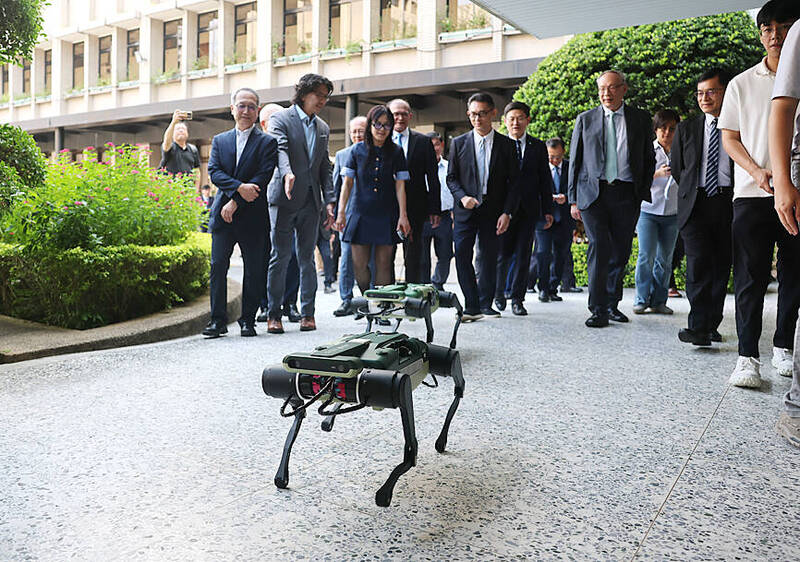
A domestically developed quadruped robot demonstrates its autonomous navigation capabilities in Taipei on Wednesday. Photo: CNA
APPLICATIONS:The robots are capable of disaster and firefighting response, autonomous navigation, swarm operations as well as underground tunnel inspections, the ministry said
By Lin Ching-hua / Staff reporter The Ministry of Economic Affairs is working with the Industrial Technology Research Institute (ITRI) and industry partners to create a homegrown program to develop four-legged robots to tap into the US$4 billion global robot dog market.
The initiative aims to leverage Taiwan’s strengths in information and communications technology, semiconductors and precision machinery to build indigenous technologies and a non-China supply chain, the ministry said.
Technology is evolving from robotic arms to wheeled, quadruped and humanoid robots with autonomous mobility capabilities, it said.
Driven by rapid advancements in generative artificial intelligence (AI), visual recognition, sensors and high-performance computing, robots are now capable of “thinking” and countries around the world are positioning themselves in this market, it added.
The global quadruped robot market is led by US and European firms — including Ghost Robotics of the US, which focuses on military and defense applications, and Switzerland’s ANYbotics, which specializes in industrial inspections for power and petrochemical sectors, the ministry said.
Some manufacturers have been investing in these developments for more than two decades, it added.
Quadruped robots are steadily expanding into industrial and consumer markets, the ministry said, adding that the global industrial market is projected to surge from below US$1 billion last year to more than US$4 billion by 2035.
The ITRI developed the platform in 18 months, establishing autonomous technologies in components, key modules, full-machine control and AI software, it said.
The platform allows local firms to leverage their expertise to develop key technologies, such as motors, light detection and ranging (LiDAR), controllers, inertial measurement units, AI computing platforms, and system integration, the ministry said.
Solomon Technology Corp (所羅門), Compal Electronics Inc (仁寶), Inventec Corp (英業達), Teco Electric & Machinery Co (東元電機), Compertum Microsystems Inc (來達科技) and NexCOBOT (創博) have jointly developed domestic modules and prototypes on the platform, it said.
To accelerate AI training, the team used Nvidia’s Taipei-1 supercomputer and the Omniverse digital twin platform to synchronously train more than 4,000 virtual robot dogs before deploying them in real-world applications, the ministry said.
So far, the platform has completed validation for four key applications: firefighting and disaster response, underground tunnel inspections, autonomous navigation, and swarm operations, it added.
The firefighting robot has passed capability verification, the ministry said, adding that it is capable of detection and search-and-rescue missions in high temperature, toxic and flammable environments.
The robot could eventually be deployed in energy facilities, petrochemical plants, smart logistics and public safety, helping spur the growth of Taiwan’s smart robotics industry, it said.
In related developments, National Chungshan Institute of Science and Technology (NCSIST) president Lee Shih-chiang (李世強) earlier in the week told lawmakers that the system for its robot dogs, which debuted last month, is being produced in Taiwan under US technology licensing.
Mass production and procurement by the military is expected to begin in 2028.
NCSIST’s robot dog system features three configurations: LiDAR, reconnaissance and combat. The institute has also revealed plans to use it in base patrols, beach defense, urban warfare and multi-domain uncrewed operations.
The timeline for mass production would depend on the operational requirements of military units, Lee was quoted by Newtalk as saying.
Different versions would be produced based on the needs identified by users, he said.
“Its applications are not limited to combat,” Lee said. “Robot dogs can also take on a range of routine missions, including military base inspections and security patrols.”
新聞來源:TAIPEI TIMES