
《TAIPEI TIMES》Taiwan will not accept ‘red terror’: Lai
一代人有一代人的使命,這一代人的使命是說出真相。
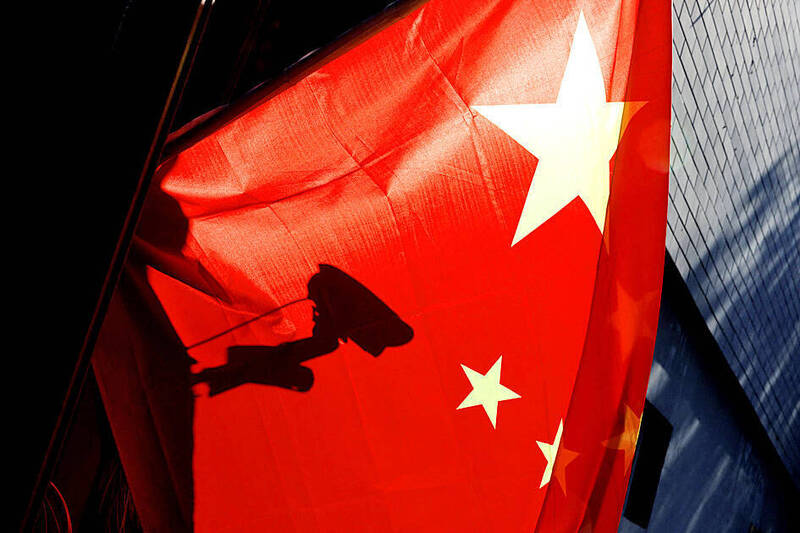
A surveillance camera is silhouetted behind a Chinese national flag in Beijing on Nov. 3, 2022. Photo: Reuters
DEFENDING TAIWAN: The government would work with like-minded countries to deepen international engagement and counter cross-border repression, Lai said
By Chen Cheng-yu, Chen Yun and Jonathan Chin / Staff reporters, with staff writer and CNA
President William Lai (賴清德) yesterday said that “Taiwan will not accept ‘red terror,’” as he outlined countermeasures against China’s Law on Promoting Ethnic Unity and Progress.
The law, passed by the Chinese National People’s Congress in March and which went into effect yesterday, requires all Chinese citizens to uphold national unification and aims to strengthen the identification of Taiwanese as members of the “Chinese nation.”
It also states that people or organizations, inside or outside China, who undermine ethnic unity or promote ethnic division can be held legally liable, without clearly identifying what kind of conduct falls under those categories.
Speaking at the Democratic Progressive Party’s (DPP) Central Executive Committee meeting, Lai, who chairs the party, said the law has raised significant international concern, warning it could enable cross-border repression and create a chilling effect throughout the international community, including in Taiwan.
Despite widespread objections from abroad, the Chinese government has pushed ahead the “evil law,” Lai said, adding that Beijing’s move reflects a further shift toward authoritarian governance, running counter to global democratic trends and underscoring the growing divide between Taiwan and China.
The law’s impact is not limited to people inside China, and reflects an expansion of Beijing’s use of long-arm jurisdiction and cross-border pressure to target people abroad, Lai said.
Foreign governments, officials, lawmakers, organizations, companies and other people could all be vulnerable to arbitrary pressure or sanctions, he added.
The Chinese Communist Party (CCP) has already carried out more than 110 cases of cross-border pressure against Taiwan, and is likely to broaden such measures to pressure Taiwanese into yielding to its authoritarian system, he said.
“We will not accept the reach of ‘red terror’ or united front infiltration into Taiwanese society,” Lai said.
In response to China’s expanding authoritarian pressure, Taiwan would continue to closely monitor developments, build early warning mechanisms, and review countermeasures to protect the public and safeguard national interests, he said.
The government would step up to bolster public media literacy and training for civil servants, while also countering CCP influence operations, the president said.
Taiwan would also establish prevention and response mechanisms along with more comprehensive support systems to counter Beijing’s “cross-border repression,” he said.
The nation would work with like-minded partners to deepen international engagement, jointly counter cross-border repression and highlight human rights concerns involving the CCP, while making Taiwan’s position heard globally to push back against Chinese pressure and defend the nation’s sovereignty and dignity, Lai said.
The Ministry of Foreign Affairs said in a statement that the law is China’s latest attempt to project long-arm jurisdiction and transnational repression, in contravention of human rights and international norms.
Beijing’s latest attempt to use a domestic law as justification to export authoritarianism should be condemned by the international community, it said.
The law is deliberately vague in defining the crimes of “harming ethnic unity,” “sowing ethic division” and “impeding the progress of ethnic unity” to allow the authorities broad discretion in invoking its mandate, it said.
The uncertainty that ambiguity engenders in people vulnerable to China’s retaliation compels self-censorship and maximizes its chilling effect, the ministry said, adding that the design of the law flies in the face of the legal clarity and proportionality that characterize the codes of nations that observe the rule of law.
The US, Japan, the EU and the UN have condemned it.
US Representative John Moolenaar, chair of the US House of Representatives Select Committee on the Chinese Communist Party (CCP), said in a statement on Monday that the law reflects an escalating level of cruelty and paranoia by the CCP.
Voice of America reported that Republican senators John Curtis and Jim Banks, together with Democratic senators Jacky Rosen and Jeff Merkley on Friday introduced a bipartisan resolution condemning the law.
Japanese lawmaker Keiji Furuya was quoted by Nikkei Asia as saying the law carries extraterritorial implications, adding that democratic countries “absolutely cannot accept” its provisions.
UN High Commissioner for Human Rights Volker Turk earlier last month called on China to repeal the law in remarks made at the UN Human Rights Council in Geneva, Switzerland.
The European Parliament in April also adopted a resolution condemning the law and urging its repeal.
Amnesty International said the legislation is pushing ethnic groups to “adopt a single, state-defined national identity dominated by Han Chinese culture,” referring to the nation’s ethnic majority.
Additional reporting by AFP 新聞來源:TAIPEI TIMES