
《TAIPEI TIMES》 Anti-communism training restored in military
獨立思考的能力,比任何制度都重要。
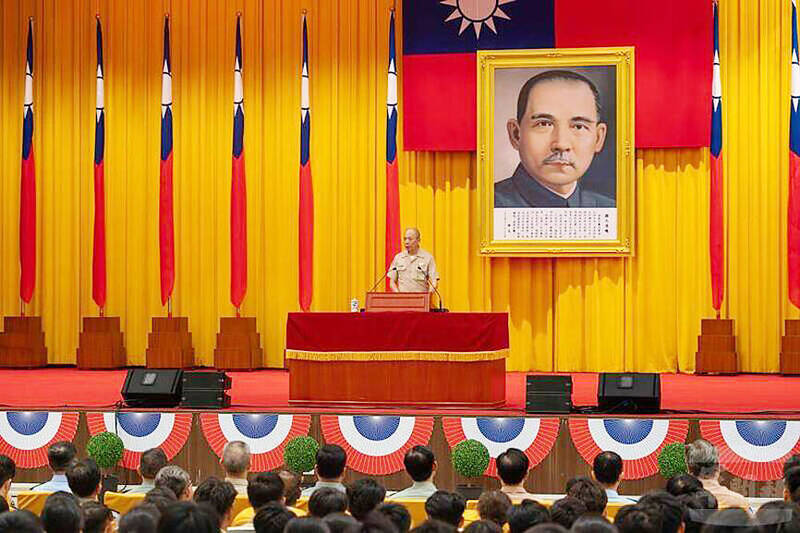
Chief of the General Staff Admiral Mei Chia-shu speaks from the podium during an “Anti-communist Patriotic Education” session at the National Defense University on Wednesday. Photo courtesy of Military News Agency
NATIONAL SECURITY: The original focus of the patriotic education program was restored due to the CCP’s continued military threat against Taiwan, the MND said
By Huang Ching-hsuan, Lo Tien-pin and William Hetherington / Staff reporters, with staff writer
The military yesterday said it has shifted the focus of its patriotic education training back to its original purpose as an anti-communism program to address the growing threat from the Chinese Communist Party (CCP).
The program, introduced in 1965, is intended to sharpen graduates’ understanding of the distinction between friend and foe by focusing on the nature of threats from China and teaching candidates why they fight and who they fight for, the Ministry of National Defense (MND) said.
The program had its name changed from “Anti-communist Patriotic Education” (反共愛國教育) to “Patriotic Education” (愛國教育) in 2002, but has shifted back this year to its focus on the threat of communism, restoring its original name, the ministry said.
The announcement follows the joint graduation ceremony for Taiwan’s eight military academies last month, presided over by President William Lai (賴清德).
Newly graduated officers would next attend the patriotism training program, the standard practice since 1965, the ministry said.
It said the decision to restore the original focus of the program was due to the CCP’s continued military threat against Taiwan as it expands its “united front” infiltration and “gray zone” activities.
As newly commissioned officers join frontline units, they must understand national security threats and the mission of defending the country, it said.
Speakers who participated in the program this year included officials from the Mainland Affairs Council (MAC), National Security Council, Ministry of Justice Investigation Bureau, and Military Intelligence Bureau, as well as academics from Academia Sinica, the MND said.
Classes cover Taiwan’s cross-strait policy, the military threat posed by the CCP, cognitive warfare, infiltration and recruitment operations, and authoritarian expansion, with the goal of fostering a clear understanding of friend and foe among graduates and preparing them to defend the nation, it said.
The graduates, who would soon begin their service as junior officers across the military, spent the week at the National Defense University’s Fuxinggang campus attending the program.
In an address on Wednesday last week, Chief of the General Staff Admiral Mei Chia-shu (梅家樹) told graduates that wearing a military rank represents a responsibility entrusted by the nation and an honor, adding that wearing the uniform means accepting the mission of defending the country and its people.
Taiwan is safer, and public confidence in the armed forces is stronger, because generations of service members have remained at their posts, he said.
Speaking on Thursday, MAC Minister Chiu Chui-cheng (邱垂正) said that while the CCP has portrayed campaigns such as its internal rectification and anti-corruption drives as efforts to ensure clean governance, their true purpose is to eliminate political rivals and consolidate power.
The CCP’s new Ethnic Unity and Progress Promotion Law expands Beijing’s claimed jurisdiction beyond its borders, undermining peace and stability across the Taiwan Strait, Chiu said.
He urged newly commissioned officers to recognize these tactics and remain steadfast in their patriotism.
Deputy chief of the general staff for intelligence Lieutenant General Hsieh Jih-sheng (謝日升) briefed graduates on the military threats facing Taiwan and frontline operational conditions, encouraging them to transform what they learned in the classroom into practical combat capability to defend the nation.
During the cognitive warfare session on Friday, National Security Council adviser Alex Huang (黃重諺) said the CCP has developed a wide range of influence operations by exploiting Taiwan’s democratic freedoms and open Internet environment to sow confusion and undermine unity between the military and the public.
Describing cognitive warfare as “a war without gunpowder,” Huang said that Taiwan has ranked as the country most heavily targeted by foreign disinformation campaigns for several consecutive years.
In the digital era, Taiwan’s service members stand on the front lines every day against cyber and cognitive threats, and must develop the ability to think independently and defend themselves against increasingly complex hybrid threats, he said.
When reached for comment, Institute for National Defense and Security Research’s Shen Ming-shih (沈明室) said that the program is designed to deepen the students’ understanding of the armed forces and national policies.
Whether the term “anti-communist” is included, the core content remains largely the same, covering topics such as the domestic and international security environment, responses to the CCP and major MND policies, Shen said.
While the substance of “anti-communist patriotic education” and “patriotic education” might be similar, the inclusion of the term “anti-communist” inevitably signals a different framing and perspective, he added.
新聞來源:TAIPEI TIMES