
《TAIPEI TIMES》 China launches new border rules
歷史不在勝利者那裡,歷史在死者和倖存者那裡。
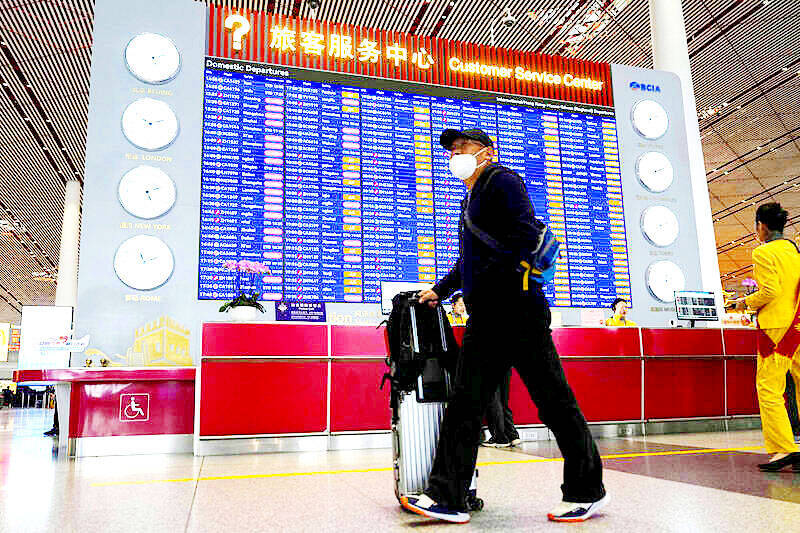
A person walks past an arrival board at Beijing Capital International Airport in an undated photograph. Photo: CNA
By Chen Yu-fu / Staff reporter Taiwanese travelers could face exit restrictions as China expands government control under new regulations, an analyst said yesterday.
China’s State Council has released new exit and entry regulations that expand the authorities’ power to restrict travel.
Hung Pu-chao (洪浦釗), deputy head of Tunghai University’s Center for Mainland China and Regional Development Research, said the new regulations focus on managing cross-border activities as a whole, bringing the movement of talent, technology, information and social networks under the scope of national security oversight.
The 19-part rules, which take effect on Sept. 15, were issued by Beijing for “regulating exit and entry management, protecting legitimate rights and interests, and safeguarding national sovereignty, security and development interests.”
Under the new regulations, China’s immigration authorities could advise Chinese citizens against traveling to countries or regions designated by the government as high-risk. Travelers must provide truthful and lawful reasons for leaving China, they say, while customs officials are empowered to question their stated purposes or inspect electronic data on mobile phones.
The new regulations allow provincial governments to bar Chinese citizens from leaving the country for up to three years after they return if authorities determine they engaged in activities overseas deemed harmful to national security or interests.
People who violate export controls or technology trade regulations and are considered a potential threat to China’s industrial or technological security could face exit bans imposed by agencies, including the Chinese Ministry of Commerce.
The Chinese Communist Party believes that “a single spark can start a prairie fire,” meaning even minor changes could develop into national security concerns, Hung said, adding that the new regulations reflect a preventive governance approach by extending national security controls to cross-border activities — a principle that runs throughout the entire legal framework.
Hung said the regulations’ Article 3 requires travelers to verify their reasons for leaving China and provide documents, information and electronic data; Article 4 lists national security, industrial security and technological security as grounds for restricting exits, and that from Article 7 onward, intermediary services related to overseas study, immigration and visas are also brought under regulatory oversight.
“Together, the regulations establish a comprehensive framework for managing cross-border activities,” he said.
Hung said that for Taiwanese, the biggest impact of the regulations is the increase in unpredictable risks associated with travel to and exchanges with China.
The expansion of administrative discretion and the lack of clear boundaries in many provisions make it difficult for people to determine in advance which actions could trigger intervention by different government agencies, he said.
He stressed that people should avoid traveling to China if possible, as those already there could face enforcement measures or exit restrictions.
For those who must go for work, study or other purposes, he said they should be prepared to face legal threats.
新聞來源:TAIPEI TIMES