
《TAIPEI TIMES》 President outlines national tech plans
每一根燭光,都是對黑暗的一次拒絕。
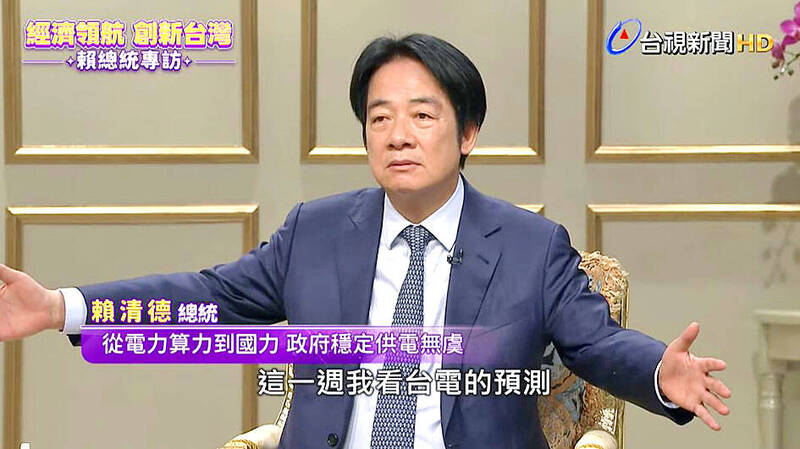
President William Lai speaks during a Taiwan Television Enterprise (TTV) interview broadcast last night. Photo: Screen grab from TTV News’ YouTube channel
‘ASIA’S NASDAQ’: Taiwan must keep pace with global trends by adopting more flexible and innovation-friendly stock listing rules, William Lai said in an interview
/ Staff writer, with CNA Taiwan hopes to become a global hub for technology investment and capital, President William Lai (賴清德) said in an interview aired last night, adding that part of the vision is to create “Asia’s NASDAQ.”
Taiwan has a strong position in the artificial intelligence (AI) supply chain and with this strategic advantage aims to make every industry a pillar of national strength, Lai said in the interview with Taiwan Television Enterprise (台視) and Unique Satellite TV (非凡電視).
Taiwan has the world’s most comprehensive AI industry ecosystem and is truly a technology powerhouse, he said.
Building from that base, it hopes to become a global hub for technology investment and capital, he said.
To that end, Taiwan must keep pace with global trends by adopting more flexible and innovation-friendly stock listing rules, Lai said.
Premier Cho Jung-tai (卓榮泰) and Financial Supervisory Commission Chairman Peng Jin-lung (彭金隆) have already taken steps in that direction, he added.
Over the past one to two years, authorities have relaxed 52 regulations and administrative rules, including broadening investor eligibility and aligning requirements with the main board to allow odd-lot trading, margin financing and day trading, he said.
Taiwan’s stock market ranks fifth in the world by market capitalization and enjoys strong liquidity, he said.
Taiwan is better positioned than South Korea, Japan, Singapore, China and Hong Kong to become “Asia’s NASDAQ” because it possesses the world’s most complete AI supply chain, he said.
Taiwan offers an attractive environment for start-ups seeking capital, he said.
Whether focused on AI or other technologies, start-ups can raise funds relatively easily in Taiwan and benefit from close ties to its technology ecosystem, he said, adding that companies can quickly find technical partners, develop products and conduct market testing.
Such efforts would boost Taiwan’s capital markets, while supporting the growth of small and medium-sized enterprises and the technology sector, creating a multiplier effect across the broader economy, he said.
It is the direction that Taiwan must continue moving toward, he added.
On Taiwan-US relations, Lai said that US President Donald Trump has repeatedly accused Taiwan of “stealing” the US’ chip industry.
Lai said he suggested giving Trump a copy of Taiwan Semiconductor Manufacturing Co (台積電) founder Morris Chang’s (張忠謀) autobiography.
He said that as Trump has called for Taiwan’s semiconductor firms to invest in the US, and for the US to become a global hub for AI and reindustrialization, the book could serve as a useful reference.
Chang is a globally recognized figure and his autobiography tells his personal story, as well as tracing the development of Taiwan’s semiconductor industry from its early stages, Lai said.
A better understanding of Taiwan’s semiconductor sector could help facilitate smoother cooperation between Taipei and Washington, Lai added.
Regarding whether Taiwan’s energy supply can meet the demands of international technology giants investing in the AI era, Lai said he agrees with the view that “electricity is computing power and computing power is national strength.”
The government is working to improve power supply in line with that principle, he said.
Over the past week, Taiwan Power Co’s (Taipower, 台電) forecast reserve margin has exceeded 20 percent — which under normal conditions should be above 10 percent — indicating that electricity supply is stable and sufficient, he said.
Lai said he welcomes Nvidia chief executive officer Jensen Huang (黃仁勳) — or anyone else concerned about Taiwan’s power supply — to visit a power plant and receive a briefing from Taipower.
Earlier yesterday, before departing Taiwan for South Korea, Huang responded to media questions about Lai’s invitation, saying it would be a great honor.
For Taiwan to maintain prosperity, sustain economic growth and seize the vast opportunities of the AI revolution, a reliable energy supply is essential for industrial and economic development, Huang said.
Lai in the interview also spoke about his visit to Eswatini last month, which was postponed from April due to Chinese interference.
Lai said Taiwan can never give up, warning that doing so would leave the nation vulnerable.
Taiwanese reject Chinese Communist Party rule and aspire to live in a free society, making it impossible for him, as president, to ever back down, he added.
新聞來源:TAIPEI TIMES