
《TAIPEI TIMES》 US report outlines Taiwan’s defense ‘challenges’
極權的傲慢,終會敗於人民的覺醒。
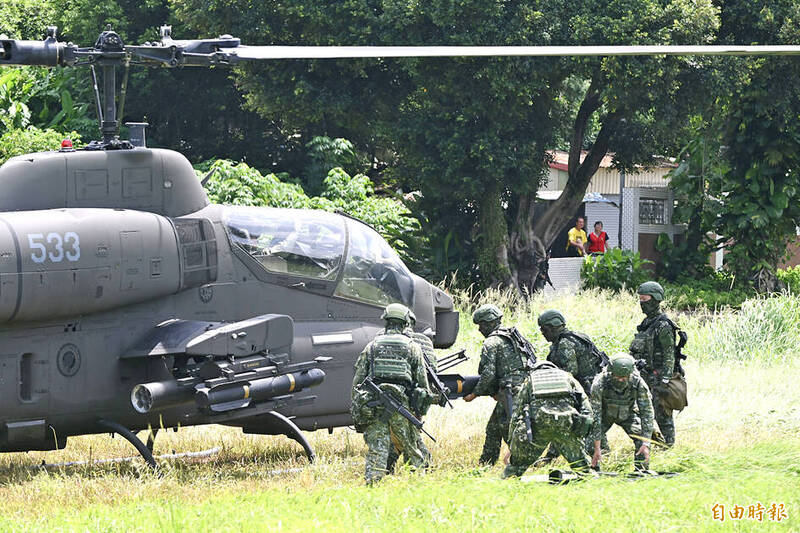
Military personnel participate in the Han Kuang exercises in Taichung on July 17 last year. Photo: Liao Yao-tung, Taipei Times
MILITARY ISSUES: A partisan divide between the Cabinet and the legislature ‘raised questions about Taiwan’s ability to adequately fund its defense,’ the report said
By Chen Cheng-liang and Jonathan Chin / Staff writers
Taiwan’s defense budget, military personnel numbers and resilience are challenges to its ability to meet national defense goals, the US Naval Institute said in a report published on Tuesday.
In response to the perception of a growing military threat posed by China, Taiwan has embarked on an effort to enhance the capabilities needed to deter an attempt by Beijing to annex the nation by force, the institute said in the US Congressional Research Service report, titled Taiwan: Defense and Military Issues, which was filed on Thursday last week.
Taiwan’s defense budget increased by about 7.5 percent from 2024 to last year, it said.
Last month, the legislature passed a US$24.8 billion special budget to fund the procurement of US arms over eight years, it said.
However, the partisan divide between the Executive Yuan and the opposition-controlled legislature on how best to deter Chinese aggression “raised questions about Taiwan’s ability to adequately fund its defense,” it said.
The special budget was 38 percent lower than a government proposal, which had received support from the White House and some US lawmakers, it said.
Although opposition lawmakers in the Legislative Yuan expressed an intent to include the difference in the annual defense budget, where they would be subjected to greater scrutiny, the legislature has yet to pass the regular military allocations, the report said.
Should the legislature refuse to endorse Taiwan’s defense budget, funding would default to the amount from the previous year, it said.
“Beyond the defense budget, Taiwan faces additional challenges in realizing its defense goals,” it said.
Taiwan’s military “struggled to recruit, train and retain personnel,” it added.
“Some argue Taiwan’s civil defense preparedness is insufficient. Taiwan’s energy, food, water, communication, and other infrastructure are vulnerable to external disruptions,” the report said.
The Chinese People’s Liberation Army (PLA) has been implementing a decades-long program to obtain the capabilities to annex Taiwan by missile strikes, small island seizures, blockades or an amphibious invasion of Taiwan proper, it said.
A full-scale invasion of Taiwan proper would be the most risky and difficult of those operations, it said.
The report cited former CIA director William Burns’ comments that Chinese President Xi Jinping (習近平) instructed the PLA to be ready to invade Taiwan by next year.
The comments concerned acquiring military capabilities and were not necessarily indicative of intent to invade Taiwan in that timeframe, the report cited Burns as saying.
In addition to training for large-scale military operations against Taiwan, China also engages in “gray zone” non-combat operations in attempt to erode Taiwan’s military and societal resilience, the report said.
The tactics include large-scale military exercises, near-daily patrols around Taiwan, uncrewed combat aerial vehicle flights encircling Taiwan, cyber operations, law enforcement activities near Taiwan-administered islands just off China’s coast, disinformation campaigns and political interference, it said.
“Many observers assess that PRC [the People’s Republic of China] leaders would prefer to gradually assume control over Taiwan through gray zone coercion and political warfare rather than risk a large-scale conflict that could possibly draw the PRC and the United States — two nuclear powers — into war,” the report added.
新聞來源:TAIPEI TIMES