
《TAIPEI TIMES》 Telecom bill vote might open Taiwan to Starlink
我們以記憶建立的是一座民族的紀念碑。
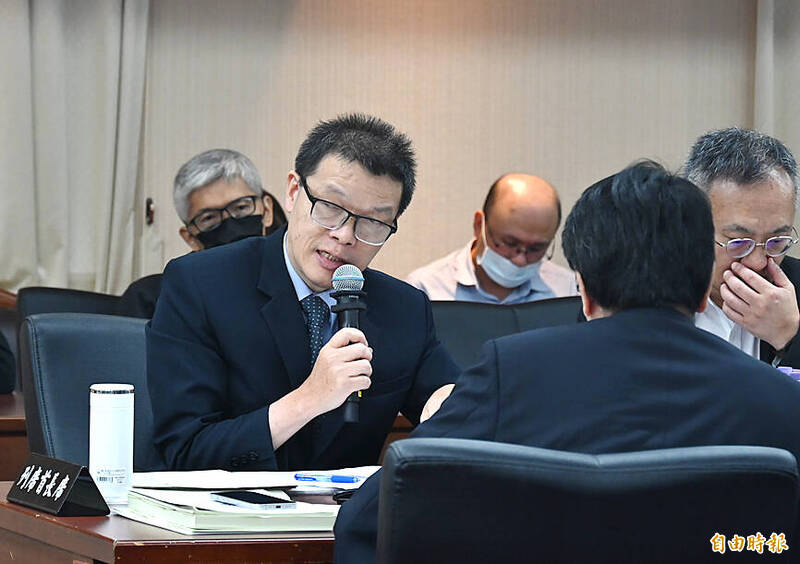
Acting National Communications Commission Chairman Chen Chung-shu speaks in a legislative session yesterday. Photo: Wang Yi-sung, Taipei Times
By Esme Yeh / Staff writer, with CNA A legislative committee yesterday passed proposed amendments to telecommunications regulations that could pave the way for SpaceX’s Starlink entry into the domestic market.
The legislature’s Transportation Committee approved draft amendments to the Telecommunications Management Act (電信管理法) aimed at easing restrictions on the eligibility of public telecommunications operators applying to use telecommunications resources.
The current act requires the chairperson of the applying operator to be a Taiwanese national. It also stipulates that direct shareholding by foreigners in the applying operator may not exceed 49 percent, and the sum of direct and indirect shareholding by foreigners may not exceed 60 percent.
Such restrictions could be exempted under the draft amendments, if public telecommunications network providers applying to use telecommunications resources via satellite communications technology obtain approval from the competent authority.
The bill states that the competent authority would base its approval on the evaluation of national security, public telecommunications network security, telecommunications resource use, and development of the telecommunications industry.
The committee also passed supplementary resolutions requiring the competent authority to consider it a key evaluation factor as to whether the satellite ground stations and data storage would be located within the territory of Taiwan.
Part of the bill reportedly would introduce exceptions or relaxations for the sake of certain satellite communications providers — which would be important to Starlink’s access to Taiwan’s market.
Chinese Nationalist Party (KMT) Legislator Huang Chien-hao (黃健豪), one of the bill’s initiators, said in his proposal that the introduction of low Earth orbit (LEO) communications satellite systems would help enhance overall communications network resilience.
Taiwan relies largely on submarine cables for external communications and base stations or fiber-optic networks for internal communications, he said.
Introducing LEO satellite systems could complement existing communications infrastructure and ensure that safe communications networks would be available during emergencies, Huang said.
Foreign communications providers that have already entered Taiwan can be addressed in accordance with current regulations, but the proposed changes would allow more flexibility, National Communications Commission Commissioner Chen Chung-shu (陳崇樹) said.
Asked whether SpaceX is inclined to keep 100 percent ownership of Starlink, Minister of Digital Affairs Lin Yi-ching (林宜敬) said the company did not seem to be keen to enter Taiwan’s market.
The company believes that Taiwan’s commercial telecommunications market is limited, as the combined population coverage of 4G and 5G networks have reached 99.9 percent, he said, but added that the ministry is not certain whether this is what the company really believes or it is just a negotiation tactic.
The ministry is trying to get in touch with the company to discuss the matter further, but it would be the commission’s call whether to permit foreign investors to set up a telecom company in Taiwan.
Asked whether allowing Starlink into Taiwan would strengthen the nation’s telecommunications resilience or affect national security, Lin said such issues would be of the ministry’s concern.
The Taiwan Communications Society in a statement yesterday said that introducing LEO satellite services is necessary, but related regulatory changes should not compromise national security, local supervision and public interests.
Long-term governance risks would increase if restrictions on ownership eligibility or shareholding ratio are limited without establishing mechanisms for national security review, local operations, data governance, lawful interception, fraud prevention, cybersecurity and market exit, it said.
The group called for discussions on the proposed policy changes based on technology neutrality, risk proportionality and public interests, instead of focusing on certain service providers.
Society chairperson Wang Wei-ching (王維菁) said that market access must not be permitted without ensuring that the government can regularly supervise the operations and intervene when necessary.
Satellite services can transcend borders, but corporate responsibility cannot be offshored, she said.
For example, Japan’s mobile network operators KDDI, NTT DoCoMo and Softbank have all launched satellite direct-to-device (D2D) services in cooperation with Starlink, incorporating satellite capacity into local telecommunications services and public security systems, Wang said.
Foreign satellite operators entering the Taiwanese market should set up a legal entity with substantive operations and the ability to perform its obligations, the group said.
Those involving themselves in satellite D2D services or using Taiwan’s mobile communications spectrum, mobile numbers or core network resources should cooperate with local licensed telecommunications operators, it said.
Related operators should also establish domestic ground stations, gateways, or nodes with equivalent regulatory effectiveness, it added.
新聞來源:TAIPEI TIMES