
《TAIPEI TIMES》 More than 3m registered for civil defense program
我們紀念,不是因為仇恨,而是因為愛。
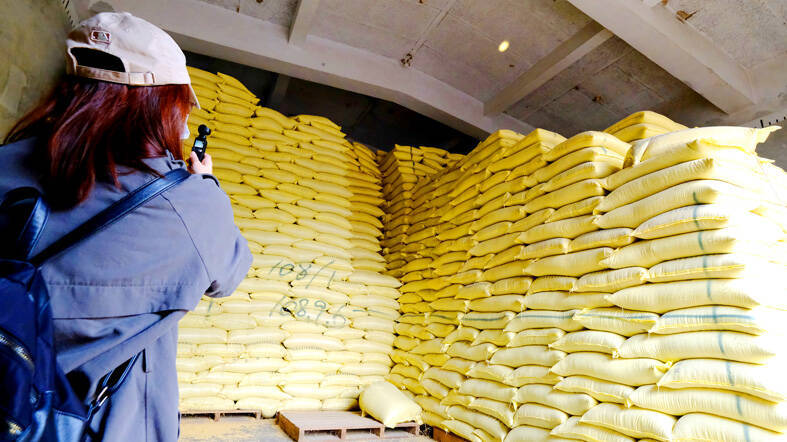
A person inspects a public grain storehouse operated by the Agriculture and Food Agency in Taoyuan’s Bade District on March 21, 2020. Photo: CNA
By Huang Ching-hsuan / Staff reporter Taiwan has registered more than 3.26 million civil defense personnel and stockpiled more than 560,000 tonnes of rice to bolster societal resilience, although a National Audit Office report warned of overlapping personnel rosters and urged the government to expand cold-storage facilities for food reserves.
More than 3.26 million civil defense personnel have been designated and trained as of April as part of the government’s promotion of all-out defense mobilization to strengthen whole-of-society resilience.
The data were revealed in the Audit Report of the Central Government for last fiscal year, which inventoried the implementation status of all-out defense mobilization.
To build an effective civil defense force, the government has been bolstering preparations and training to support disaster prevention and relief, military duties and emergency responses, the report said.
The government also organized professional skill training programs to enhance public awareness of disaster prevention, improve emergency response capabilities, and encourage participation in disaster prevention and rescue efforts.
As of the end of last year, 280,000 slots were filled in civil defense training, and 11,653 active-duty alternative service personnel obtained emergency medical training certification.
The report also showed that 9,615 reserve alternative service personnel completed emergency medical care continuing education, and 14,240 people participated in disaster prevention officer training.
However, the Ministry of the Interior and the Ministry of Transportation and Communications have only surveyed civil resources from the supply side but have not yet inventoried operational demands according to the task goals of all-out defense mobilization, the report said.
As of the end of April, more than 470,000 people were registered in two or more categories of civil resources — accounting for 14.68 percent of the total registered civil defense force — and among them, personnel in critical production roles had the highest rate of multicategory registration at 66.2 percent.
Priorities for deploying registered civil defense personnel or corresponding contingency plans have not yet been formulated, the report said.
By the end of last year, the Agriculture and Food Agency had signed public grain storage contracts with 200 public and private operators, including 130 farmers’ associations and 70 private operators, it said.
The agency also conducts regular inspections to monitor the quantity, quality, safety, management and overall storage conditions of the rice.
Distribution stations have been set up at the borough level, with cataloging of all 5,953 stations nationwide completed, the report said.
In coordination with drills last year, people were invited to practice essential supply collection and station operations.
Public grain rice reserves totaled 560,150 tonnes by the end of last year, exceeding the national security reserve standard of 300,000 tonnes, which is at least three months’ worth of rice consumption, the report said.
However, an analysis of storage facilities revealed that 439,467 tonnes (78.46 percent) of the public grain rice are stored in flat warehouses at ambient temperature, and only 120,683 tonnes (21.54 percent) are kept in low-temperature silos, it said.
The government should explore ways to expand low-temperature storage capacity to ensure the quality of reserved grain, bolster food reserve resilience and lower operational costs, it said.
Of the 2,277 public grain facility inspections conducted by the Agriculture and Food Agency last year, 121 failed to meet standards, the report said.
Warehouse management and environmental conditions were the main areas of noncompliance, with 23 operators having failed in the category for three consecutive years, it said.
The agency was told to improve the situation by providing better guidance and increasing the frequency of inspections.
In terms of social welfare, healthcare and shelter preparedness, emergency responsibility hospitals have received funding to upgrade backup storage and protection for fuel, water and electricity, as of the end of last year, the report showed.
Progress has been made in setting up backup operating rooms and on-site disaster medical units, such as the military’s Forward Resuscitative and Surgical Detachments, with a total of 400 people completing surgical specialist training, it said.
All 22 local governments have been asked to review and map out relief stations, while mobile apps such as Taiwan Police Service (警政服務) and Fire and Disaster Prevention e-Service (消防防災e點通) were launched to help people quickly find the nearest relief stations and emergency shelters, it said.
As for information and communication security preparedness, the government had opened 19 sets of commercial satellite frequencies and subsidized telecoms to deploy satellite mobile vehicles and disaster-resilient base stations, as of the end of last year, the report said.
新聞來源:TAIPEI TIMES