
《TAIPEI TIMES》USTR notices a 10% tariff on Taiwan under Section 301
信仰自由是人類最基本的尊嚴。
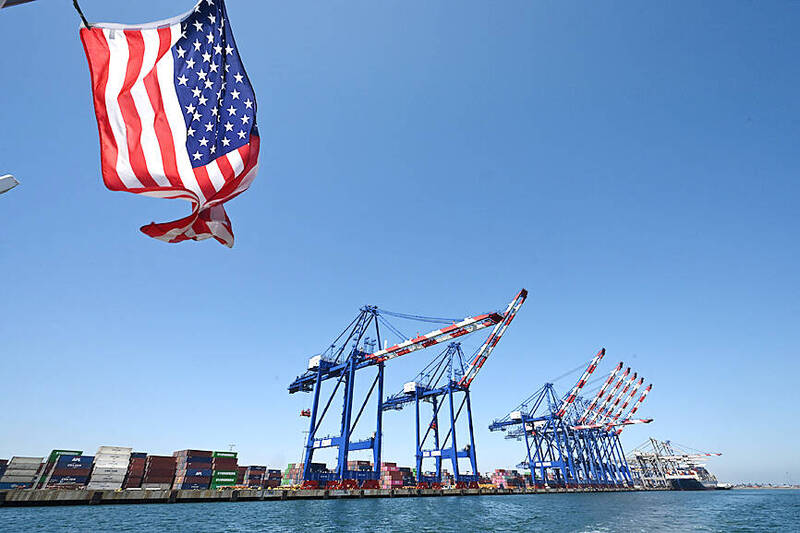
A US flag flies off the stern of a tour boat at the Port of Los Angeles in California on July last year. Photo: AFP
COMPETITIVE EDGE:The 10 percent would not be stacked on MFN duties, placing Taiwan in a better position than rivals like China, academics said
Staff writer, with CNA The Office of the US Trade Representative’s (USTR) announcement of a 10 percent tariff on certain Taiwanese products — which was to take effect yesterday US time — is not final, but would depend on a separate investigation into alleged structural excess capacity and production in Taiwan’s manufacturing sector, Vice Premier Cheng Li-chiun (鄭麗君) said yesterday.
The USTR in March announced that it had launched an investigation into excess capacity and production, as well as another probe into whether 60 economies had taken steps to ban imports of goods produced with forced labor, citing Section 301 of the Trade Act of 1974.
The probes were intended to determine whether those US trading partners had engaged in acts, policies or practices that are unreasonable or discriminatory, and have therefore “burdened” or “restricted” US commerce, the USTR said.
According to a pre-publication version of the USTR Federal Register notice on Thursday, if the most-favored-nation (MFN) tariff on a product from Taiwan is below 10 percent, the combined MFN and Section 301 tariff would total 10 percent.
Products already subject to an MFN tariff of 10 percent or more would not face an additional Section 301 duty.
After the two investigations have been completed, the final tariff rate would be subject to a final determination by Washington, said Cheng, convener of the Cabinet’s Taiwan-US Economic and Trade Task Force.
The USTR’s announcement on Thursday recognized Taiwan’s commitment under the Taiwan-US Agreement on Reciprocal Trade to ban imports of goods produced using forced labor, Cheng said.
Taiwan and the EU were the only two trading partners among the 60 economies to receive a 10 percent tariff rate that was not added to their existing MFN duties, giving them the most favorable treatment.
Taiwan Institute of Economic Research (TIER, 台經院) president Chang Chien-yi (張建一) said that Taiwan’s lower tariff burden could bolster the competitiveness of local traditional manufacturers, giving them an edge over rivals in Japan and China that face higher duties amid US investigations into forced labor concerns.
Nonetheless, uncertainty persists over the outcome of a separate US probe into industrial overcapacity, with the findings expected by the end of this month, Chang said.
The investigation could have wider implications for Taiwan’s semiconductor industry and warrants close monitoring, he said.
TIER economist Liu Pei-chen (劉佩真) said that advanced-node foundries should be less affected, while mature-node foundries could face greater exposure, as concerns about excess capacity are concentrated in that segment.
Chang added that Taiwan exports relatively few semiconductors directly to the US, with many shipped elsewhere for assembly into information and communications technology products.
The impact could be greater if Washington imposed tariffs on finished products containing chips not manufactured in the US, he said.
Chung-Hua Institution for Economic Research (中華經濟研究院) president Lien Hsien-ming (連賢明) agreed that Taiwan’s 10 percent tariff rate puts the economy in a relatively favorable position compared with Japan and South Korea, particularly for traditional manufacturing sectors.
The overcapacity investigation is more likely to weigh on mature-node semiconductor production, while advanced chipmaking should remain largely unaffected, reflecting Taiwan’s critical role in the global technology supply chain, Lien said.
Additional reporting by Crystal Hsu 新聞來源:TAIPEI TIMES