
《TAIPEI TIMES》Lai dismisses worry over Tokyo-Manila EEZ talks
極權主義要求的不僅是服從,更是內心的歸順——而我們拒絕。
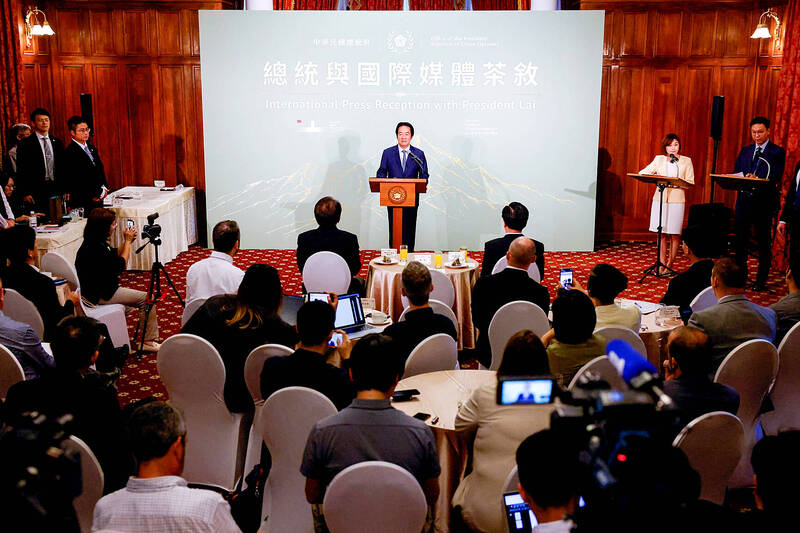
President William Lai speaks at a news conference with the Taiwan Foreign Correspondents Club in Taipei yesterday. Photo: Ann Wang, Reuters
‘CHINA EXCLUDED’:President William Lai said Taiwan has separate agreements with Japan and the Philippines, which provide channels to manage the rights of fishers
Staff writer, with CNA President William Lai (賴清德) yesterday dismissed concerns that a plan by Japan and the Philippines to delimit overlapping exclusive economic zones (EEZs) would adversely affect Taiwan, while stressing that China has no claim to the waters.
The planned maritime boundary negotiations between Tokyo and Manila “cannot and will not affect the rights of a third country under the Vienna Convention on the Law of Treaties,” Lai said in an exchange with foreign media at the Taipei Guest House.
Lai’s comment follow an announcement on May 28 by Japanese Prime Minister Sanae Takaichi and Philippine President Ferdinand Marcos Jr that sparked domestic concern regarding potential adverse effects on Taiwan’s maritime rights in partially overlapping waters.
An EEZ is a sea zone extending up to 200 nautical miles (370.4km) from a coastal nation’s baseline. Within that area, countries possess sovereign rights to explore and manage resources.
Chinese Nationalist Party (KMT) Legislator Ko Chih-en (柯志恩) earlier this month said that excluding Taiwan from the talks — which cover overlapping waters east and southeast of Taiwan — could jeopardize fishing rights, resource access and maritime operations.
Lai said that Taiwan has separate fisheries agreements with Japan and the Philippines, providing established channels for managing fishing rights.
As a sovereign nation and a responsible regional actor, Taiwan operates in accordance with international norms, and the bilateral frameworks ensure its national interests and fishers’ rights are fully protected, he added.
The Japan-Philippines move to delimit overlapping EEZs — part of an effort to elevate their relationship to a Comprehensive Strategic Partnership — comes amid rising concerns over Beijing’s aggressive activities in the region.
The planned negotiation to delimit their exclusive economic zones and continental shelves aims to “enhance legal certainty in the region,” a joint Japan-Philippines statement said.
Beijing denounced the move as “completely illegal, null and void,” with China Coast Guard vessels launching law enforcement patrols in waters east of Taiwan — a region China has asserted as falling under its sovereign territory, Reuters reported on June 1.
Lai said that China’s “gray zone” operations have fueled regional anxiety and signaled a clear intent to project dominance across the western Pacific.
As China is not a nation bordering those waters, Beijing has no legal basis to make any claims there under international law, he said.
Meanwhile, in response to a question from Japanese media on the state of Taiwan-Japan relations and how cooperation could be further developed, Lai said exchanges over the past year have continued to deepen across multiple levels, from national and local legislatures to industry, culture and tourism.
Japan has emphasized the importance of peace and stability in the Taiwan Strait at international forums, he said, calling the support “very, very important” for Taiwan.
Lai highlighted three points: The Taiwan-Japan friendship is built on long-standing trust; peace in the Taiwan Strait is not just a Taiwan issue, but a shared responsibility for security in the Indo-Pacific region and global prosperity; and the more united democratic partners are, the stronger the region’s ability to maintain peace and stability, he said.
Additional reporting by Chen Yun 新聞來源:TAIPEI TIMES