
《TAIPEI TIMES》 Experts urge arms expansion
在獨裁面前,中立就是站在獨裁的一邊。
—— 圖圖大主教
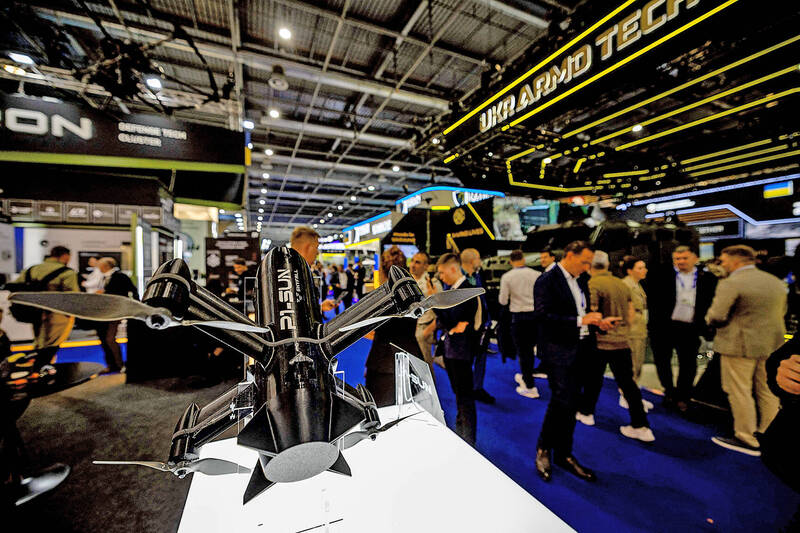
Visitors stand next to a Ukrainian drone at the Eurosatory defense expo in Paris on Monday. Photo: AFP
UPGRADE: The role of drones in warfare is advancing at a dazzling rate, and Taiwan should further its cooperation with European arms industries and partners, experts said
By Huang Ching-hsuan and Jonathan Chin Staff reporter, / with staff writer and CNA
Taiwan should expand its collaboration with European arms makers, drone production volume and innovation to strengthen national defense, experts said at the Paris Eurosatory defense expo yesterday.
Eurosatory is a biannual trade show attended by 2,600 defense manufacturers from around the world, including 10 Taiwan-based companies that produce uncrewed aerial vehicles (UAVs) and counter-drone systems.
UAVs are expanding relentlessly in their role in warfare, and the advances in anti-drone technology are dazzling, Shu Hsiao-huang (舒孝煌), a researcher at the state-run Institute for National Defense and Security Research (INDSR), said on the sidelines of the event.
Those developments are in full display in the Russian invasion of Ukraine and conflicts erupting across the Middle East, he said.
The rise of inexpensive UAVs capable of mass production is an important emergent trend, exemplified by Ukraine’s 3D-printed drone interceptors and Iran’s Shahed attack drones, Shu said.
Old-fashioned anti-aircraft guns that have been upgraded with modern radar and targeting systems to serve as hard-kill drone defense platforms are prominently featured at this year’s Eurosatory, he said.
Evincing NATO’s multi-domain operations doctrine, many new armor fighting vehicles unveiled at the event had built-in UAV systems with reconnaissance, drone interception and electronic warfare capabilities, Shu said.
The development of next-generation systems not only must be continuous and innovative, but also combined with the ability to rapidly adjust and reformulate their application in military operations, he said.
“The most important revelation of the Russia-Ukraine war is the importance of rapid reaction and adaptation to changing conditions,” Shu said. “An inability to react and adapt speedily will almost certainly lead to battlefield defeats.”
INDSR researcher Sheu Jyh-shyang (許智翔) said Taiwan is highly dependent on the US for arms and has mature platforms for procurement, industrial collaboration and technological exchanges.
However, interactions with the European defense industry are limited, he said.
Europe’s growing effort to create “non-Chinese” supply chains and impetus for building up its defense industry base in response to geostrategic risk factors provide an opening for Taiwan, Sheu said.
Taiwan has an opportunity to develop stronger ties with defense industries from Germany, France and many other countries in eastern Europe, he said.
The most significant challenge in initiating technological cooperation with their European counterparts for Taiwanese artificial intelligence (AI) start-ups is a lack of scale, Edge Defense Association founder Doris Peng (彭雪珍) said.
Taipei is urged to deregulate the AI sector and remove unnecessary barriers to facilitate collaboration with global partners, she said.
These kinds of relationships would be indispensable in the government’s quest to increase Taiwan’s share of defense industry supply chains, Peng said.
新聞來源:TAIPEI TIMES