
《TAIPEI TIMES》 Greenpeace warns about overfishing
他們是學生、工人、母親、市民——他們不是暴徒。
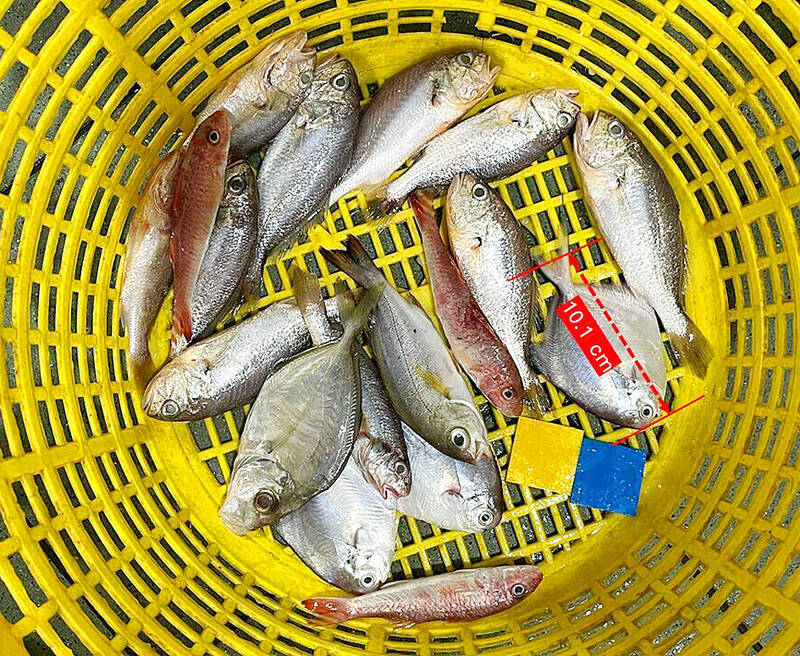
Small fishes in a basket are pictured in an undated photograph. Photo courtesy of Greenpeace Taiwan
/ Staff writer, with CNA Smaller fish are making up an increasing share of Taiwan’s inshore and offshore catches, a sign indicating overfishing, Greenpeace Taiwan said yesterday as it released a study result.
The three-year study shows that the proportion of fish caught before reaching “Lm50” — the length at which 50 percent of a species reaches sexual maturity — rose to 93.3 percent last year from 77.7 percent in 2022.
Lm50 is an important indicator of fish population health and a key reference point for fisheries management, Greenpeace said.
The nongovernmental organization conducted the survey primarily through sampling at seafood auction markets, supplemented by data collected from fish vendors. The study covered fishing harbors in Kaohsiung, and Yilan, Pingtung and Penghu counties.
National Kaohsiung University of Science and Technology Department of Aquaculture associate professor Ho Hsuan-ching (何宣慶), who participated in the research, said the survey points to severe overfishing.
Without effective management measures, fish populations could face bottleneck effects that result in progressively smaller fish, Ho said.
In turn, usable fishery resources would decline and could even be mostly depleted within the current generation, he said.
The investigation also found evidence of extensive trawling activity in prohibited waters.
Although the Fisheries Act (漁業法) bans trawling within 3 nautical miles (5.6km) of shore, trawlers logged more than 30,000 operating hours off Yilan County from 2023 to last year, Greenpeace said.
Penghu and Pingtung counties each recorded more than 10,000 hours in the same period, it added.
The Fisheries Agency recorded only 24 penalties for illegal trawling last year, while authorities in Yilan, Penghu and Pingtung counties recorded zero, Greenpeace Ocean Project director Huang Hsin-tung (黃欣彤) said.
The waters within 3 nautical miles of shore serve as important breeding and nursery grounds for many marine species, Huang said, adding that the areas remain subject to intensive fishing with insufficient oversight from central and local governments.
Greenpeace urged the Fisheries Agency and local governments to improve law enforcement efforts and allocate more funding for marine conservation.
In response, the Fisheries Agency said it respected the group’s advocacy efforts, but added that long-term monitoring of fish population structures is needed before determining why fish are becoming smaller.
Factors such as catch selectivity, the age and size of fish entering waters around Taiwan, and changes in biological maturity levels must also be considered, the agency said.
Size limits have already been established for species including mangrove crabs and mahi-mahi based on scientific research, while local governments have adopted fisheries management measures, including seasonal and area-based restrictions, and minimum catch sizes, it said.
The agency said it has been conducting long-term assessments of major commercial fish species and is working with the Fisheries Research Institute and the National Academy of Marine Research to develop medium and long-term projects and secure funding for fishery resource assessments.
Measures such as reducing the number of operating fishing vessels, regulating fishing gear and methods, managing economic coastal species, protecting habitats, restoring resources and strengthening enforcement are all aimed at maintaining sustainable fishery resources, it added.
Annual fish catches have remained at about 170,000 tonnes over the past five years, it said.
The agency also said it penalized 64 trawling-related violations from 2023 and last year.
It also argued that Taiwan’s fisheries involve a wide variety of fishing and trading practices, including auctions, direct sales and transactions with processing plants, so relying primarily on data from fish markets could introduce sampling bias.
新聞來源:TAIPEI TIMES